
Germany’s Gas Storage Is Only 54% Full: What Does It Mean for Your Winter and Your Energy Bill?
Germany’s gas storage facilities are around 54% full, well below last year’s level. Although an extreme scenario suggests they could be depleted by February, that does not mean the country is about to run out of gas. Here is what the real risk is and what it could mean for your heating bill.
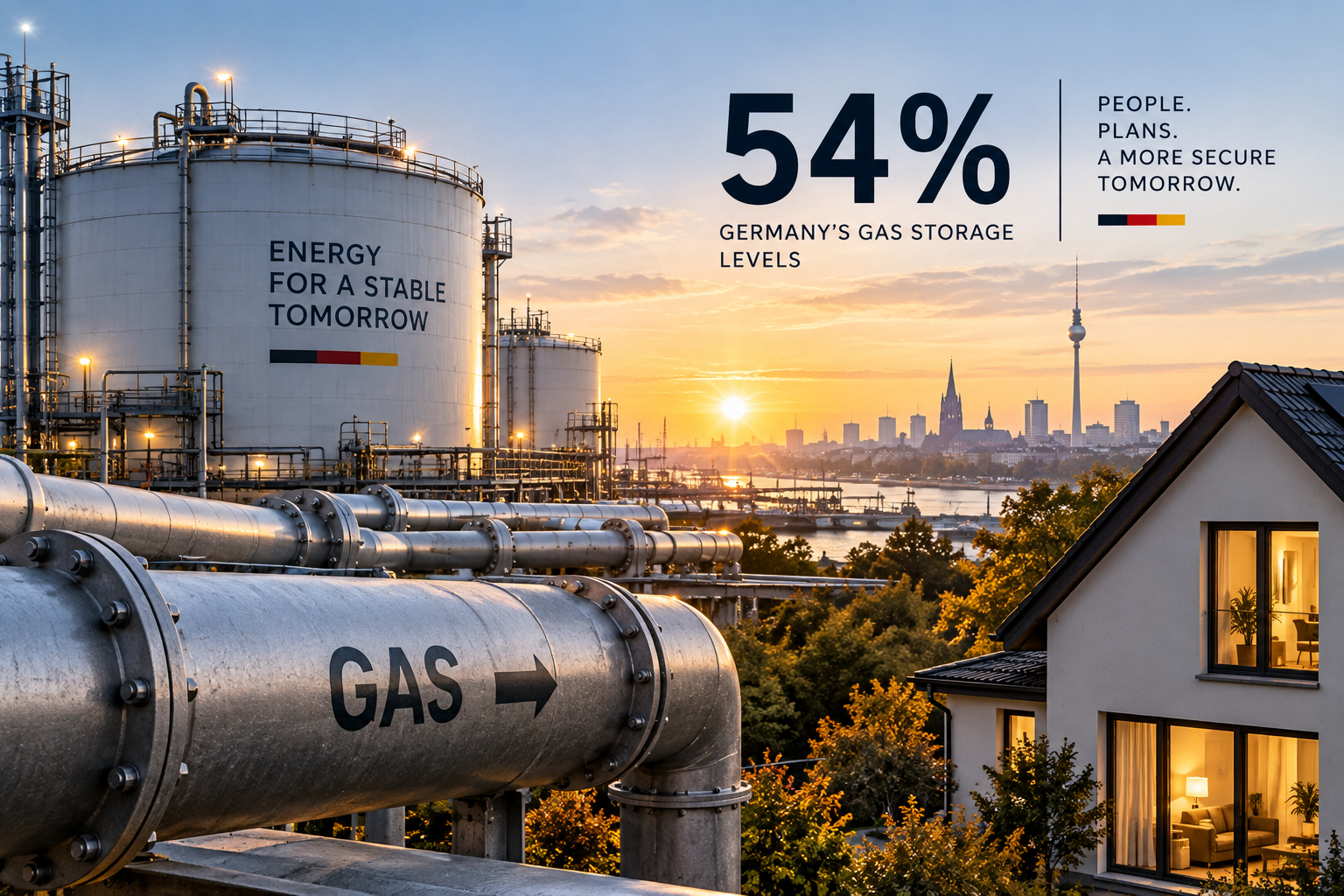
- Germany’s gas storage facilities are around 54% full, well below last year’s level.
- Although an extreme scenario suggests they could be depleted by February, that does not mean the country is about to run out of gas.
- Here is what the real risk is and what it could mean for your heating bill.
Germany is approaching the heating season with considerably less gas in storage than it had a year ago.
At the beginning of September, German gas storage facilities were approximately 54% full, around 19 percentage points below their level at the same time in 2025.
And now a headline has appeared that understandably attracts attention: under a particularly severe scenario, Germany's storage facilities could be completely depleted by early February.
Does that mean Germany is at risk of running out of heating gas this winter?
Not necessarily.
To understand the situation, three things need to be separated: how much gas is currently stored, how much Germany can continue importing during the winter, and how cold the winter actually becomes.
The important part in 30 seconds
- German gas storage facilities are currently around 54% full, considerably below last year's level.
- The industry estimates that storage could reach approximately 77% by 1 November if the pace of injections increases.
- According to INES scenarios, a mild or normal winter could be managed without exhausting stored gas.
- Completely depleted storage becomes a serious scenario mainly under an exceptionally cold winter, comparable with 2010.
- Germany's Federal Network Agency currently says supply is secure thanks to a combination of storage, pipeline imports, LNG and international supply.
The number: 54%
That is approximately how full Germany's gas storage facilities currently are.
But a gas storage facility does not work like the fuel tank in a car.
Being 54% full does not mean Germany only has the gas already sitting underground and that supply stops once it has been consumed.
Storage mainly acts as a seasonal buffer. Gas can be stored when supply is available and withdrawn when demand rises, particularly during the colder months.
At the same time, Germany continues to receive gas from abroad.
That makes the storage level important, but it is not the only measure of Germany's energy security.
Could the storage facilities really be empty by February?
Yes, but the context changes the meaning of that headline considerably.
Germany's storage industry association, Initiative Energien Speichern (INES), has modelled several scenarios for the coming winter.
Its calculations assume that storage could reach approximately 77% by 1 November. According to INES, reaching that level would require the current pace of injections to increase.
If the winter is mild or has normal temperatures, the stored reserves would be sufficient under those models.
The problem appears in an exceptional scenario:
an extremely cold winter comparable with 2010.
Under those conditions, gas consumption could rise enough to deplete stored reserves by early February.
Worth knowing: “Germany's gas storage could be empty in February” is a stress scenario, not a forecast that this will happen.
That distinction matters.
Empty storage would not automatically mean Germany has no gas
This is probably the most important part of the story.
Storage is only one component of Germany's gas system.
Germany also receives gas through pipelines, particularly from countries such as Norway, and has capacity to import liquefied natural gas (LNG) through terminals on its coasts.
Following the energy crisis triggered by Russia's invasion of Ukraine, Germany significantly expanded its ability to source gas through alternative routes.
The Federal Network Agency currently says that sufficient gas is available on the global market and that Germany has sufficient import capacity. According to the regulator, German gas supply is stable and security of supply is currently guaranteed.
This means that if storage levels begin falling too quickly during the winter, Germany can attempt to compensate by buying and importing additional gas.
But that leads to another important distinction:
having gas available and obtaining it cheaply are not necessarily the same thing.
So what is the real risk?
The more realistic risk is probably not as simple as:
“Germany will run out of gas.”
If Germany experiences an exceptionally cold winter or further pressure develops in international energy markets, the country may need to compete for additional gas supplies.
Buying additional gas during a period of strong international demand can be expensive.
That is why relatively low storage levels can matter even if a physical shortage never occurs.
The system may continue to work.
It may simply become more expensive to keep it supplied.
Why are storage levels so low?
This part of the story is largely economic.
The traditional gas-storage model was relatively straightforward:
buy cheaper gas in summer → store it → sell it during winter when prices are normally higher.
But that model becomes less attractive when the difference between summer and winter prices is too small.
According to INES, a significant share of storage capacity has already been booked, but booked capacity is not the same thing as filled capacity.
Companies still need an economic reason to buy gas and put it into storage.
If buying gas today, storing it for several months and selling it during winter offers little return — or even creates a loss — there is less incentive to fill storage quickly.
That is one reason storage operators are calling for measures that make gas injections economically more attractive.
Are there rules about how full storage must be?
Yes.
Germany maintains legal storage targets for certain dates during the year.
Under the current rules, the general target for 1 November is 80% for storage facilities, although specific exceptions apply to a number of sites.
For 1 February, the general target is 30%, again with specific rules applying to certain facilities.
These targets exist because storage plays an important role in keeping the system resilient during the heating season.
But energy security does not depend on one percentage alone.
It also depends on imports, demand, temperatures and conditions in the international gas market.
What could this mean for your heating bill?
Again, two things need to be separated:
security of supply
and
the price of gas.
Germany can have enough gas while still facing relatively high prices.
If a cold winter forces buyers to purchase large additional volumes on international markets, those costs can influence what energy companies and suppliers pay and may eventually affect consumers.
That does not mean your bill will automatically increase because storage is 54% full today.
Your final cost depends on factors such as:
- your contract;
- when your supplier purchased its gas;
- wholesale market prices;
- taxes and charges;
- your consumption;
- the efficiency of your home;
- winter temperatures.
It is therefore too early to turn today's storage level into a precise prediction of your next heating bill.
Worth knowing: a relatively low storage level is something worth monitoring. It is not a direct calculator of what you will pay for heating.
If you rent your home in Germany
If your building uses central gas heating, you will normally not buy the gas directly yourself.
Your landlord or building management contracts the energy supply, and your share of the cost later appears in your Heizkostenabrechnung, or heating-cost statement.
That means higher gas prices may take time to become visible to you.
Instead of trying to predict the winter today, it is more useful to understand your own consumption and compare your statements.
Look at:
- actual energy consumption;
- price paid per unit;
- billing period;
- monthly advances;
- the relationship between consumption and total cost.
This helps you distinguish between a higher bill caused by using more energy and one caused by paying more for the same amount.
If you own your home
If you are a homeowner with your own gas contract, you have somewhat more control over the price you pay.
It can be useful to know:
- when your current tariff ends;
- whether your price is fixed or variable;
- your annual consumption;
- your current price per kWh;
- what alternative tariffs are available.
But even here, changing your contract simply because of one headline about gas storage would not necessarily make sense.
The right decision depends on your own tariff and the alternatives available to you.
Is Germany back in 2022?
No.
The energy crisis of 2022 is still fresh in people's minds, but Germany's supply structure has changed since then.
Germany now has greater LNG import capacity and continues to receive substantial volumes of gas through pipelines.
That does not eliminate risk.
International gas markets can still be affected by supply disruptions, geopolitical conflicts and sharp price movements.
But it means that a low storage level should not be interpreted in exactly the same way as it was four years ago.
The Federal Network Agency stresses that security of supply depends on the interaction between:
imports + storage + LNG + infrastructure + demand.
Not on one percentage alone.
One thing you can do today
You do not need to buy an electric heater or immediately change energy provider.
There is something far more useful you can do:
find out how much gas or heating energy you actually use.
Take your latest *Heizkostenabrechnung* or gas bill and note:
1. your annual consumption;
2. how much you paid for that consumption;
3. your current monthly advance payment;
4. whether your home uses gas for heating;
5. when your contract ends, if you hold the contract yourself.
With that information, you can react rationally if energy prices change over the coming months.
Without it, every headline about gas prices is mostly noise.
The AORAES takeaway
Germany's gas storage facilities are significantly less full than they were a year ago.
That is worth paying attention to.
But 54% does not mean Germany has only half the gas it needs to survive the winter, nor does it mean the country is about to run out of heating.
Under a normal winter scenario, current models do not expect stored reserves to be exhausted. The risk rises considerably if the winter becomes exceptionally cold.
And even then, Germany does not rely on storage alone: it can continue importing gas through pipelines and LNG terminals.
For consumers, the more useful question may therefore not be:
“Will Germany run out of gas?”
but:
“What could a tighter gas market eventually mean for the price I pay?”
That is the difference between reading a headline and understanding what is actually behind it.
---
Sources
- Federal Network Agency (Bundesnetzagentur) — Current gas-supply situation and storage levels, September 2026.
- Initiative Energien Speichern (INES) — Scenarios for German gas storage during winter 2026/27.
- AGSI+ / Gas Infrastructure Europe — German gas-storage data.
- Federal Network Agency — German storage-level requirements.
*Last updated: 8 September 2026.*
Put the information into your own situation.
Check which personal facts, deadlines and conditions are relevant before deciding. A guide explains the framework; it does not replace individual advice.
Was this useful?
Save it to return to it, or share it with someone who may need it.
Build connected understanding.

The AfD Won 43.8%. Should You Worry About Your Salary, Taxes or Pension?
The AfD clearly won the Saxony-Anhalt election, but it has not formed a government. Here is what could actually change for your taxes, housing, job, pension and investments — and what a state election cannot change overnight.
10 min read · Published: 08 September 2026Read article →
Germany Is Growing Again, but Its Industry Is Falling: What’s Really Going On?
Germany’s economy is growing again, yet industrial production has fallen sharply. That is not a contradiction. Here is what is really happening — and why it matters if you live, work or invest in Germany.
8 min read · Published: 07 September 2026Read article →
Before You Invest in Germany: 6 Checks to Know Who You’re Really Sending Your Money To
BaFin has issued new warnings about financial platforms allegedly operating without the required authorisation. Before sending money, these six checks can help you understand who is really behind an investment offer.
9 min read · Published: 07 September 2026Read article →