
Germany Could Be Short 723,000 Skilled Workers by 2029: What Does It Mean for Your Career and Salary?
Germany could face a shortage of 723,000 skilled workers by 2029. But that does not mean every profession will benefit equally. Here is what the numbers actually mean for jobs, salaries and international professionals in Germany.

- Germany could face a shortage of 723,000 skilled workers by 2029.
- But that does not mean every profession will benefit equally.
- Here is what the numbers actually mean for jobs, salaries and international professionals in Germany.
Germany is facing a situation that seems contradictory at first. Unemployment has risen and many companies are hiring more cautiously, yet numerous sectors are still struggling to find people with the qualifications they need.
That problem could become significantly larger over the next few years. According to a new projection by the German Economic Institute (Institut der deutschen Wirtschaft, IW), Germany's skilled-worker gap could reach 723,000 people by 2029.
The number is striking, but it needs context: it does not mean that Germany will have 723,000 open jobs available to just anyone. The real issue is the mismatch between the qualifications companies need and the skills available in the labour market.
The important part in 30 seconds
- Germany could face a shortage of 723,000 skilled workers by 2029 if the trends analysed by the IW continue.
- That would be around 47% more than in 2024, but the shortage is far from equal across all professions.
- For workers in highly sought-after fields, this may mean more opportunities and stronger negotiating power, although it does not automatically guarantee higher salaries.
The number: 723,000
To understand that figure, it helps to know a term commonly used in Germany: Fachkräftelücke.
In simple terms, it describes the gap between the qualified workers companies need and the people available who have the right training and skills to fill those positions.
That is why people can be looking for work while companies are simultaneously unable to fill certain vacancies. It is not enough for workers to be available: their skills and qualifications need to match what employers actually need.
This mismatch is a central part of Germany's Fachkräftemangel, or shortage of skilled workers.
Will Germany definitely be short exactly 723,000 workers?
No. The IW itself makes clear that this figure is not an exact prediction of the future, but a projection based on how Germany's labour market developed between 2018 and 2024.
In other words, the study asks a simple question: what could happen if the trends observed during those years continued until 2029?
The economy, immigration, actual retirement ages, career choices, education and future investment could all change the outcome considerably. The 723,000 figure should therefore be understood as a signal of a structural problem, not as a guaranteed number.
Worth knowing: 723,000 does not mean 723,000 job vacancies waiting for applicants. It is an estimate of the potential gap between jobs requiring qualified workers and the people available with the right skills to fill them.
Where are workers actually needed?
The shortage is not spread evenly across the German economy.
According to the IW, one of the largest individual gaps could emerge in sales and retail occupations, where more than 39,000 skilled workers could be missing by 2029.
Current data from Germany's Federal Employment Agency (Bundesagentur für Arbeit) tells a similar story from another perspective. In its analysis of the 2025 labour market, it identified 157 occupations experiencing shortages of qualified workers.
Areas where employers continue to face particular difficulties include:
- nursing and care
- medical professions
- construction and skilled trades
- early childhood education
- professional drivers
- hospitality and gastronomy
At the same time, the Federal Employment Agency stresses that Germany is not currently experiencing a general labour shortage across every profession. In many sectors, there are still more available workers than job openings.
That distinction changes the way the headline should be interpreted.
How can unemployment rise while companies still cannot find workers?
Because the labour market is not one large pool in which any worker can fill any job.
Imagine a company urgently needs a specialised nurse or a qualified professional in a particular skilled trade. There may be hundreds of unemployed people living in the same city, but that does not mean they have the training required for that vacancy.
The right candidate might also live in another region, still be waiting for professional recognition, or simply be unwilling to accept the conditions being offered.
That is why an economy can experience higher unemployment and shortages in specific professions at the same time.
Why could the problem get worse?
One of the most important factors is demographic change. A growing share of Germany's *baby-boom* generation is reaching retirement age, meaning many experienced workers will leave the labour market over the coming years.
Those positions will need to be filled by someone else.
The IW also points out that the future of Germany's labour market will depend on factors such as skilled immigration, effective retirement ages, education and career choices, and investment in training and economic transformation.
The outcome is therefore not predetermined. Germany can reduce part of the gap by training more workers, making it easier for qualified professionals to enter the labour market and better aligning available skills with what companies need.
What could this mean for your salary?
This is where it is important not to jump to conclusions.
A shortage of skilled workers does not automatically mean higher salaries.
However, having a qualification that is difficult to find can improve a worker's position when it comes to negotiating.
There is a significant difference between applying for a job where dozens of suitable candidates are available and working in a profession where several companies have been trying for months to find someone with your profile.
In the second situation, you may have more room to negotiate things such as:
- salary
- working hours and flexibility
- holiday allowance
- remote work, where the profession allows it
- employer-funded training
- additional benefits
- responsibilities
- working conditions
The outcome will still depend on your profession, experience, region, employer and, in many cases, the applicable collective agreement or *Tarifvertrag*.
Worth knowing: a shortage in your profession does not mean your employer will automatically increase your salary. Scarcity may improve your alternatives, but negotiation still matters.
Sometimes the most valuable thing is not the salary
Working in an in-demand profession can offer something that does not appear directly on your payslip:
more options.
If several companies need your profile, it may become easier to change employers, look for better conditions, specialise further, negotiate your next position or reject an offer that does not suit you.
And having alternatives matters.
Someone who needs to accept almost any available offer negotiates from a very different position than someone who can choose between several employers interested in hiring them.
So when you think about your career, the question should perhaps not only be:
How much can I earn?
It may also be worth asking:
How much demand is there for the skills I have?
If you are an international professional in Germany
This topic is particularly relevant for people who moved to Germany from another country.
The IW identifies skilled immigration as one of the factors that could influence how Germany's labour shortage develops over the coming years. That may create opportunities for international professionals, particularly in fields where companies struggle to fill vacancies.
But working in an in-demand profession does not automatically remove the barriers to entering the German labour market.
Depending on your profession, factors such as these may still be important:
- your German language level
- recognition of your qualification (*Anerkennung*)
- professional licences or authorisations
- work experience
- specific specialisations
- knowledge of the German labour market
This is particularly important in regulated professions, where professional experience from another country does not necessarily mean you can start working in Germany immediately.
A simple example
Imagine two people who currently earn exactly the same salary.
The first works in a profession where many suitable candidates are available for every vacancy. The second has a specialisation that several companies have been trying to find for months.
Their current salaries may be identical, but their situations can look very different when they decide to search for a new job.
The second person is not guaranteed to earn more. But they may have more interested employers, more opportunities to compare offers and more freedom to reject conditions they do not like.
That is negotiating power.
One thing you can do today
You do not need to change careers because you read one statistic about the German labour market.
There is something much more useful you can do: find out what is happening specifically in your profession in Germany.
Look at:
1. how many vacancies currently exist;
2. which regions have the highest demand;
3. which requirements repeatedly appear in job advertisements;
4. which specialisations employers are looking for;
5. which salaries are currently being offered;
6. which skills could improve your position over the next few years.
Germany's Federal Employment Agency publishes labour-market information by profession, making it possible to look much more closely at where employers are genuinely struggling to find qualified workers.
Because saying that "Germany needs workers" is far too general to base a career decision on.
The much more useful question is:
Does Germany need what you know how to do?
The AORAES takeaway
The potential shortage of 723,000 skilled workers is a sign of an important shift in Germany's labour market, but it does not mean every profession will benefit equally.
Germany can simultaneously experience unemployment in some sectors and significant worker shortages in others. That is why it matters less whether Germany has a *Fachkräftemangel* in general and much more what is happening specifically in your profession.
Understanding your position in the labour market can help you make better decisions about specialisation, changing jobs and salary negotiations.
Because your professional financial situation does not depend only on how much you earn today.
It also depends on something we often forget to consider:
How difficult would it be to replace what you know how to do tomorrow?
---
Sources
- Institut der deutschen Wirtschaft (IW) — *Arbeitsmarkt: 2029 fehlen 723.000 Fachkräfte*, 7 September 2026.
- Institut der deutschen Wirtschaft (IW) — *IW-Arbeitsmarktfortschreibung 2029: Beschäftigungspotenziale sinken*, 7 September 2026.
- Bundesagentur für Arbeit — *Fachkräfteengpassanalyse 2025*, 2026.
*Last updated: 7 September 2026.*
Put the information into your own situation.
Check which personal facts, deadlines and conditions are relevant before deciding. A guide explains the framework; it does not replace individual advice.
Was this useful?
Save it to return to it, or share it with someone who may need it.
Build connected understanding.

The AfD Won 43.8%. Should You Worry About Your Salary, Taxes or Pension?
The AfD clearly won the Saxony-Anhalt election, but it has not formed a government. Here is what could actually change for your taxes, housing, job, pension and investments — and what a state election cannot change overnight.
10 min read · Published: 08 September 2026Read article →
Germany Is Growing Again, but Its Industry Is Falling: What’s Really Going On?
Germany’s economy is growing again, yet industrial production has fallen sharply. That is not a contradiction. Here is what is really happening — and why it matters if you live, work or invest in Germany.
8 min read · Published: 07 September 2026Read article →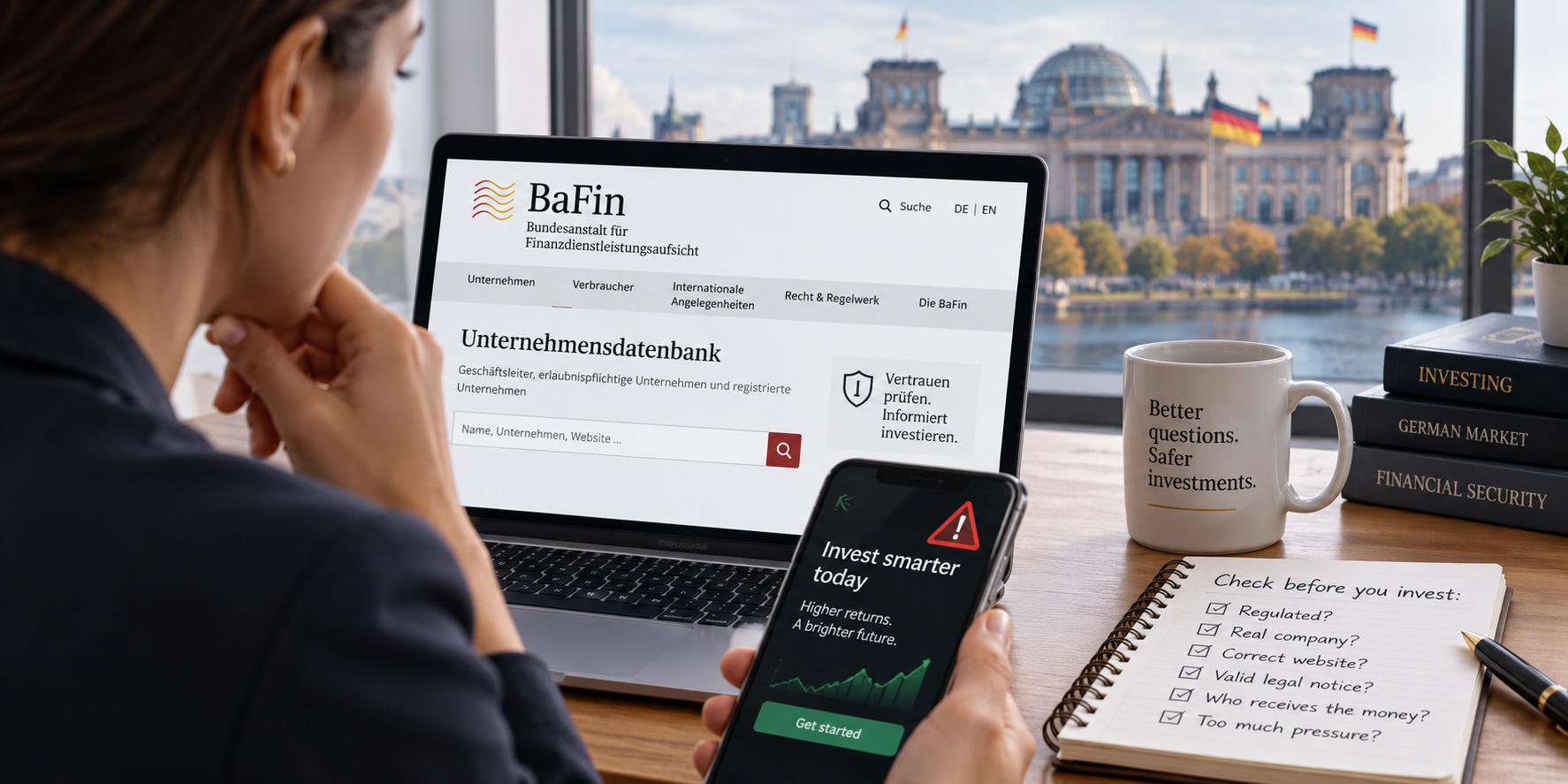
Before You Invest in Germany: 6 Checks to Know Who You’re Really Sending Your Money To
BaFin has issued new warnings about financial platforms allegedly operating without the required authorisation. Before sending money, these six checks can help you understand who is really behind an investment offer.
9 min read · Published: 07 September 2026Read article →