
Before You Invest in Germany: 6 Checks to Know Who You’re Really Sending Your Money To
BaFin has issued new warnings about financial platforms allegedly operating without the required authorisation. Before sending money, these six checks can help you understand who is really behind an investment offer.
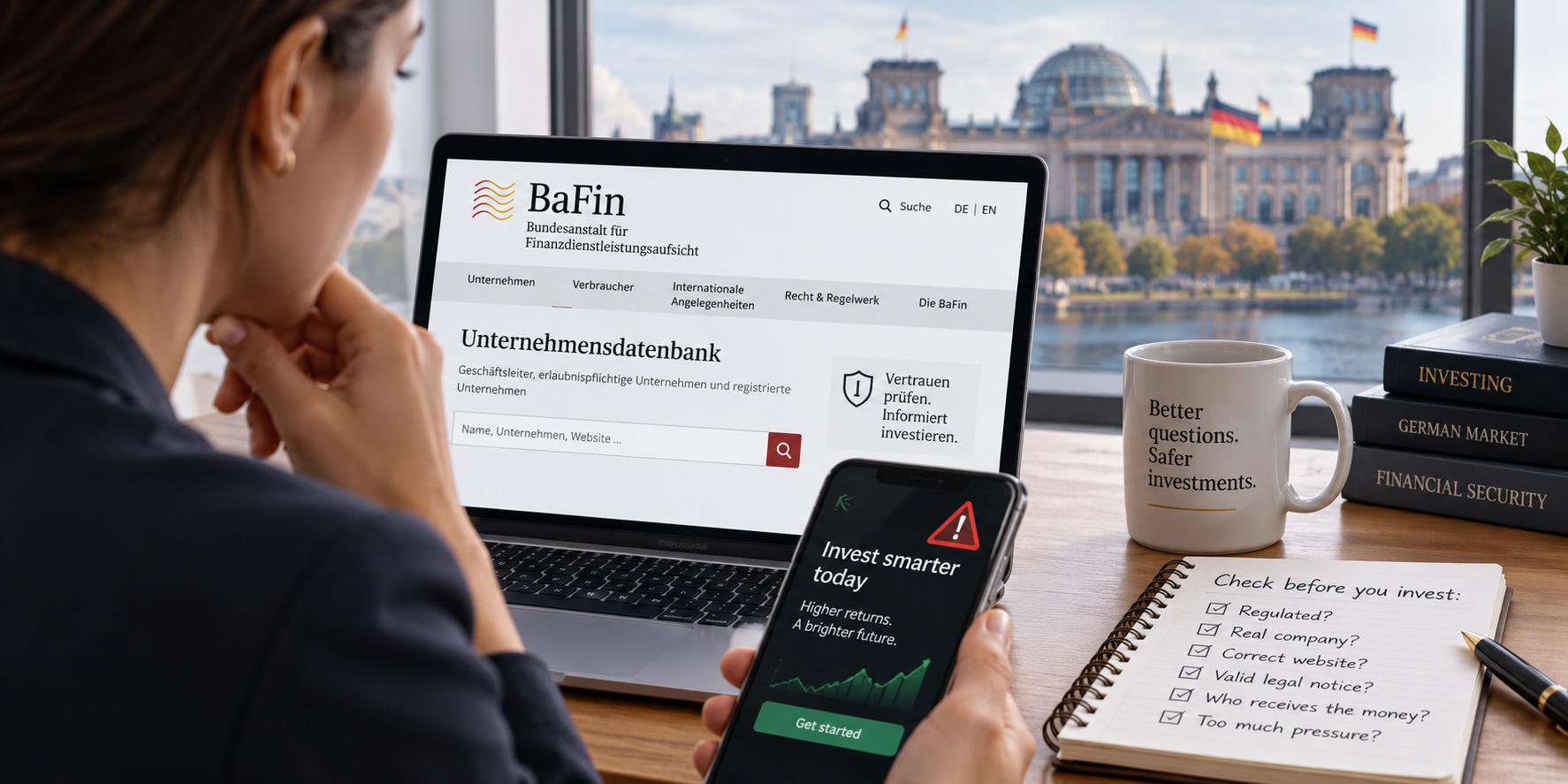
- BaFin has issued new warnings about financial platforms allegedly operating without the required authorisation.
- Before sending money, these six checks can help you understand who is really behind an investment offer.
Investing online has never been easier.
Within minutes, you can open an account, verify your identity and transfer money from your phone. The problem is that creating a website that looks professional has also never been easier.
This week, Germany's financial regulator BaFin issued several new warnings about websites allegedly offering financial, investment or crypto-asset services without the required authorisation.
The warnings included rheinbridge(.)capital, cptvertex(.)com, rollincapital(.)com and 37mh(.)com.
One of the warnings also referred to suspected identity misuse.
The lesson is not that every financial platform should be treated with suspicion.
It is much simpler:
before sending money, make sure you know who is actually on the other side.
The important part in 30 seconds
- A professional website, a German address or even a reference to BaFin does not by itself prove that a platform is authorised.
- BaFin provides an official company database that can help you verify regulated or authorised entities.
- Finding a real company name is not enough: you should also check whether the company, website and contact details actually match.
- Authorisation does not mean an investment is suitable for you or that you cannot lose money.
What happened this week?
In early September 2026, BaFin published several warnings within just a few days.
For rheinbridge(.)capital, the regulator stated that there was suspicion that unknown operators were offering financial and crypto-asset services without the necessary authorisation.
In the case of rollincapital(.)com, BaFin said the operators claimed business locations in Baar, Switzerland, and Munich, while there was suspicion that financial or investment services were being provided without authorisation.
For 37mh(.)com, BaFin was even more specific: it stated that the website did not have a valid legal notice and that its claim of being supervised by BaFin was not true.
And in the case of cptvertex(.)com, BaFin not only warned about allegedly unauthorised financial and investment services, but also referred to suspected identity misuse.
The names of the websites may change.
The method you use to protect yourself is far more valuable in the long term.
1. Search BaFin before relying on Google
When people want to check an investment platform, the first instinct is usually to search its name on Google.
That can be useful as a first look, but it should not be your main verification method.
For activities in Germany that require financial authorisation, BaFin's company database — Unternehmensdatenbank — can help you identify supervised or authorised companies.
The important part is to search for the company's exact legal name, not simply the brand name shown in large letters on the website.
A platform might call itself:
Example Invest
while the actual legal entity behind it should be clearly identifiable as something such as:
Example Invest GmbH
or another specific company.
If you cannot establish which legal entity you are actually dealing with, that is already an important question to resolve before transferring money.
Worth knowing: failing to find the brand name you expected does not automatically prove fraud. European structures, trading names and different legal entities can make things more complicated. The goal is to verify who is actually providing the service and under which authorisation.
2. Do not check only the company name — check the website too
This is where one of the more dangerous problems appears: identity theft or identity misuse.
Someone can find a genuine financial company in an official register and think:
“Great, this company exists.”
But that still does not prove that the website contacting you actually belongs to that company.
Real company details can be copied.
The name can be almost identical.
A website may even display the address, registration information or name of a genuine regulated business.
That is why you should compare:
- exact legal entity;
- website domain;
- physical address;
- email address;
- telephone number;
- regulatory information;
- legal notice details.
If you find a genuine company in an official register, independently locate its official channels and confirm its website and contact details from there.
Do not rely only on the information given to you by the person trying to sell you the investment.
3. Check the legal notice — but do not treat it as proof
People living in Germany are used to seeing an *Impressum*, or legal notice, on professional websites.
It is a useful check.
Depending on the business, you should be able to identify information such as:
- responsible company;
- address;
- authorised representatives;
- company registration details;
- contact information;
- relevant regulatory information.
Missing important legal information can be a warning sign.
In fact, BaFin specifically stated in its warning about 37mh(.)com that the website did not have a valid *Impressum*.
But there is a catch:
an Impressum can also be copied.
A Frankfurt, Berlin or Munich address printed on a website does not prove the company is genuinely located there.
The legal notice tells you what the website claims to be.
Official registers help you test whether that story makes sense.
4. Verify every claim about regulation independently
Statements such as:
“BaFin regulated”
“EU regulated”
“Licensed financial institution”
can create instant trust.
But a sentence on a website is not a licence.
In one of its September 2026 warnings, BaFin explicitly stated that a website claimed to be under its supervision when this was not true.
So when a platform says it is regulated, the useful question is not:
“Does the website say it is regulated?”
It is:
“Can I verify that regulation directly with the official source?”
There is another distinction worth remembering:
regulated does not mean guaranteed returns.
An authorised provider can offer investments that rise or fall in value. Regulation helps establish who is providing certain services and under which framework, but it does not remove investment risk.
5. Slow down when the relationship begins with pressure
Not every questionable investment begins with a suspicious-looking website.
Many begin with a conversation.
It might be through:
- WhatsApp;
- Telegram;
- a phone call;
- an advertisement;
- Instagram;
- Facebook;
- a supposedly private investment group.
When you see a combination of:
extraordinary returns + urgency + persistent personal contact
slow the process down.
A serious investment opportunity should survive questions.
You should be able to say:
“I'll review this tomorrow.”
And have exactly the same information available the next day.
BaFin, Germany's Federal Criminal Police Office and the state criminal police authorities generally advise consumers to be particularly careful with online investments and to research them thoroughly beforehand.
A useful rule: the stronger the pressure to send money quickly, the stronger your reason to verify everything slowly.
6. Check where your money is actually going
Before making a bank transfer, stop at the final screen.
Look at the beneficiary.
Does it match the entity you believe you are dealing with?
If you thought you were investing with:
Example Investment GmbH
but the transfer is going to an account belonging to:
John Smith
or another company that has never appeared anywhere in the process, understand why before proceeding.
The same principle applies to crypto-assets.
If you are asked to send assets directly to a wallet, make sure you understand who controls that wallet and what realistic options you would have to recover the assets after the transfer.
The payment is the point where a convincing story turns into real money.
It is worth checking one more time.
A beautiful website does not prove a legitimate business
This matters more than ever in 2026.
A few years ago, fraudulent websites often looked bad.
Spelling mistakes.
Strange design.
Poor translations.
That advantage has largely disappeared.
Professional-looking websites, convincing financial copy, images and even realistic-looking profiles can now be created using tools available to almost anyone.
That means visual quality has become a much weaker way of judging credibility.
“It looks professional” is no longer a security check.
Good reviews are not enough either
Reviews can help you understand other users' experiences, but they should not be your main verification tool.
There can be:
- fake reviews;
- reputation campaigns;
- paid comments;
- reviews from customers who have never tried to withdraw money;
- different platforms using very similar names.
Your investigation should begin with facts you can independently verify:
**Which company is this?
Who regulates it?
Where is it registered?
Does the domain actually belong to it?**
Then look at reviews.
Not the other way around.
What if you have already sent money?
Do not ignore the situation because you feel embarrassed or because someone tells you that you simply need to “deposit a little more to unlock your withdrawal.”
If something does not seem right, preserve all available evidence:
- contracts;
- emails;
- chats;
- screenshots;
- payment confirmations;
- names and phone numbers;
- wallet addresses;
- bank account information.
Depending on the circumstances, it may also be important to contact your bank or payment provider quickly and consider legal or police assistance.
BaFin also accepts information about businesses suspected of conducting activities that require authorisation without having that authorisation.
However, a complaint to BaFin does not automatically stop legal deadlines and does not guarantee that an individual investor will recover their money.
One thing you can do today
Think about the last financial platform you opened.
Your broker.
Your crypto platform.
An investment app.
Or the company that recently appeared in an advertisement.
Spend five minutes answering these questions:
1. What is the company's exact legal name?
2. Who supervises or authorises it?
3. Can I verify that using an official source?
4. Do the website and contact details match?
5. Is the legal notice coherent?
6. Do I know exactly who would receive my money?
If you can clearly answer all six, you know significantly more about the platform than you did five minutes ago.
If you cannot answer them, it may not yet be time to transfer money.
The AORAES takeaway
Online, trust can be designed.
An elegant logo, a German address, a friendly adviser or even the name of a genuine financial company can make a platform appear legitimate.
But appearance should not be enough when your money is involved.
Before asking:
“How much could I make?”
there is a more fundamental question:
“Do I actually know who I am sending my money to?”
Answering that question may be one of the most valuable financial checks you ever make.
---
Sources
- Federal Financial Supervisory Authority (BaFin) — Current warnings concerning unauthorised business, September 2026.
- BaFin — Company Database (*Unternehmensdatenbank*).
- BaFin — Consumer information on recognising questionable investment offers.
- BaFin — Information on complaints and unauthorised businesses.
*Last updated: 7 September 2026.*
Put the information into your own situation.
Check which personal facts, deadlines and conditions are relevant before deciding. A guide explains the framework; it does not replace individual advice.
Was this useful?
Save it to return to it, or share it with someone who may need it.
Build connected understanding.

The AfD Won 43.8%. Should You Worry About Your Salary, Taxes or Pension?
The AfD clearly won the Saxony-Anhalt election, but it has not formed a government. Here is what could actually change for your taxes, housing, job, pension and investments — and what a state election cannot change overnight.
10 min read · Published: 08 September 2026Read article →
Germany Is Growing Again, but Its Industry Is Falling: What’s Really Going On?
Germany’s economy is growing again, yet industrial production has fallen sharply. That is not a contradiction. Here is what is really happening — and why it matters if you live, work or invest in Germany.
8 min read · Published: 07 September 2026Read article →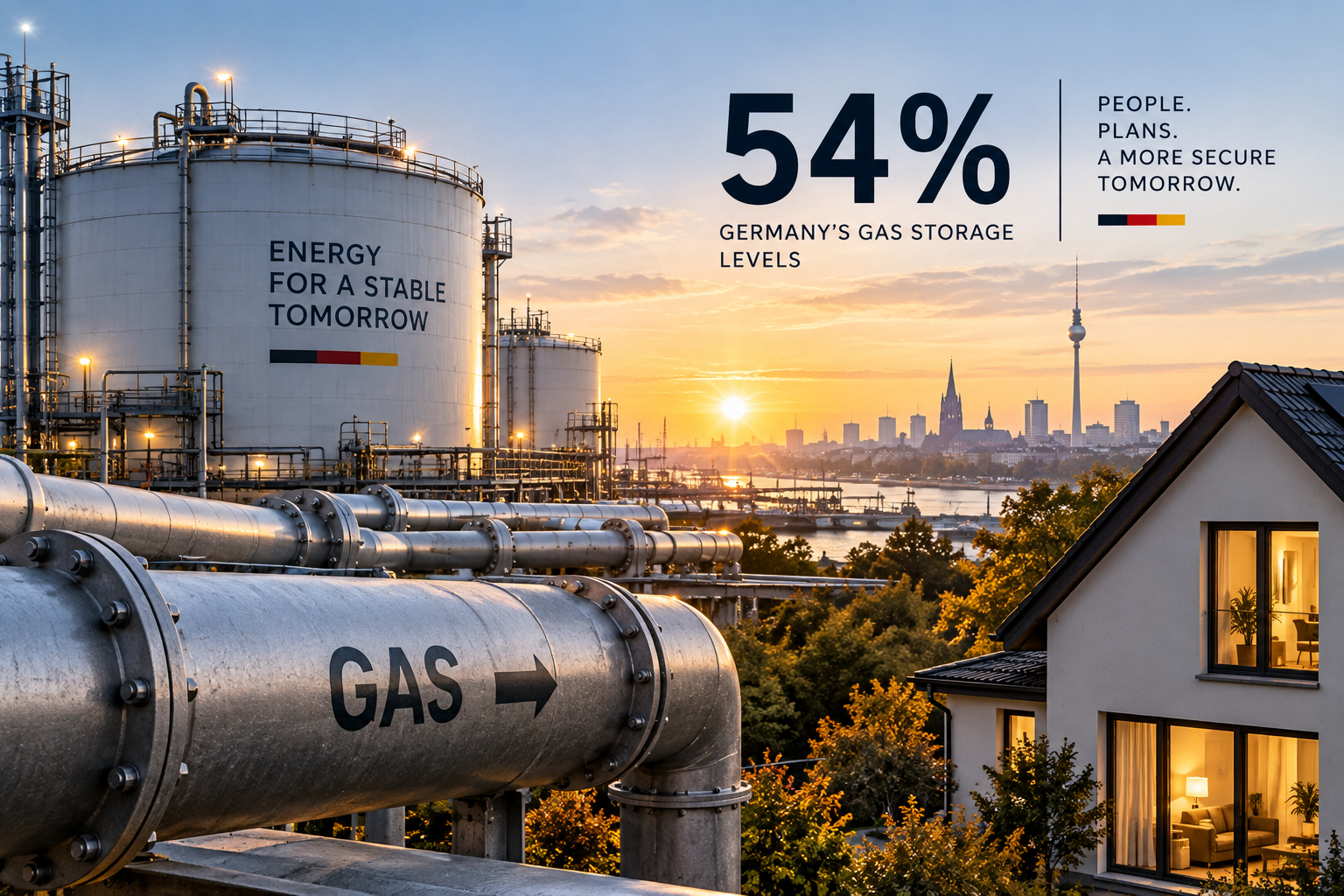
Germany’s Gas Storage Is Only 54% Full: What Does It Mean for Your Winter and Your Energy Bill?
Germany’s gas storage facilities are around 54% full, well below last year’s level. Although an extreme scenario suggests they could be depleted by February, that does not mean the country is about to run out of gas. Here is what the real risk is and what it could mean for your heating bill.
9 min read · Published: 08 September 2026Read article →